
To help the country emerge as a true welfare State, political parties must put the country's interests first before strategising to win elections and short-term goals, argues Ramesh Menon.

'India should start leveraging rather than banning crypto.'

'Two consecutive quarters of negative growth are the technical definition of an economic recession, and for the first time in this generation's memory, we may be staring at one,' observes Aakar Patel.

'Politicians's slogans on social distancing, showered like petals from their ivory towers, mock every single moment of pain and distress imposed on the vulnerable down below, at migrant labour stuffed like chickens on goods trucks, trying to get home at all costs,' observes Veenu Sandhu.

'The term 'pro-growth' must be qualified somewhat because, while a rising tide will lift all boats, it will not necessarily do so equally.'

The Centre for Monitoring Indian Economy said sectors like machinery (with a weight of 18 per cent in the index for industrial production), chemicals (14.5 per cent), basic metal (12.4 per cent), rubber, plastic and petroleum products (11.8 per cent) and transport equipment (11 per cent) would be the growth engine for this year. The projection is based on analysis of projected capacity and expected capacity utilisation of major industries.

'In countries like Japan, one out of 11.7 tests turns out to be positive, which is among the highest in the world. Italy tests 6.7 persons for one positive test while the USA tests 5.3 persons and the United Kingdom 3.4'

It was women who unambiguously bore the brunt of the lockdown joblessness, says Kanika Datta.
India's agricultural production could see its biggest drop in more than two decades this year, due to a drought that hit nearly one-third of the country, Centre for Monitoring Indian Economy said on Friday.

When it comes to losing a job permanently, the youngest and the oldest segments in the workforce have reported an increase in setbacks in the second wave of the pandemic, a survey of by a Fortune500 company has said. The survey, conducted in April this year, covered 2,000 persons in India. Six per cent of those over 55 years of age reported having permanently lost their job, as against 4 per cent last year. In those aged under 24, the proportion reporting a permanent job loss has increased to 11 per cent from 10 per cent in the year-ago period, the survey done by financial technology company FIS said.
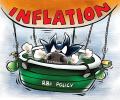
The Reserve Bank of India on Friday raised the retail inflation forecast for 2021-22 to 5.7 per cent due to supply side constraints, high crude oil and raw materials cost. The RBI in June had pegged the retail inflation estimate at 5.1 per cent for the current financial year. The RBI has the mandate to keep inflation in a band of 2-4 per cent, with a tolerance level of 2 per cent on either side.

New projects fell 6.3 per cent in the December quarter compared with the September quarter. The value of new projects in the just-concluded quarter was Rs 2.1 trillion, according to the data from Centre for Monitoring Indian Economy (CMIE), which was lower than the Rs 2.2 trillion seen in the September quarter. It is, however, higher than Rs 1.5 trillion recorded for the quarter ended December 2020, the first year of the Covid-19 pandemic. This data ties in with the November data for core sector growth, an index of eight core industries, which grew at its slowest pace since early 2021.

Urban men lost more jobs than women during the second wave of COVID-19, implying a complete loss of livelihood for millions of households, according to the Centre for Monitoring Indian Economy (CMIE). The most disproportionate loss of jobs because of the first wave of COVID-19 was among urban women, CMIE's MD and CEO Mahesh Vyas said in his analysis. He said urban women account for about three per cent of total employment, but they accounted for 39 per cent of total job losses in the first wave of the pandemic.

Even after five decades of use, the telescope at Ooty that Dr Govind Swarup designed and built continues to be the largest single frequency radio telescope in the world.
CMIE further said that it has dropped its forecast for sugar production during 2009-10 due to an expected fall ofeight per cent in sugarcane. Similarly, because of the expected fall in oilseeds, CMIE dropped its forecast for production of edible oil.

Emerging technologies like cybersecurity and the Internet of Things have the potential to add 1.4 million new IT jobs in India by 2027.

Concern is growing among healthcare experts who believe that if people do not follow the lockdown or social distancing seriously, the situation can quickly go out of control.

Welcoming the reduction in pollution, environmentalists urged the government to treat it as a "wake-up call" and stop its "obsession" with "development" at the cost of the environment.

As employers eye quality talent, employees will enjoy an upper hand in demanding high pay, better benefits, remote work options and other perks, predicts Navneet Singh, CEO, Avsar, a talent management firm.

As India looks to mend its Covid-battered economy, one thing that will grab the attention of all concerned is the path that both wholesale and retail inflation will follow. Even the Reserve Bank of India in its latest policy statement said, "Going forward, the inflation trajectory is likely to be shaped by uncertainties impinging on the upside and the downside.

India has lost almost the entire buffalo meat export market to Brazil, Australia and the US.

Had Finance Minister Sitharaman thought a little more about the middle class, disadvantaged sections, and the poor who are struggling, it would have been an inclusive Budget that would have made history, notes Ramesh Menon.
The Centre for Monitoring Indian Economy on Monday pegged the growth of Indian economy at 7.5% for the first quarter of 2004-05 and that for the entire next fiscal at 6.3%.
Rising rupee and higher base have decelerated Indian companies' topline growth to 15.1 per cent for the quarter ended September 2007, the Centre for Monitoring Indian Economy said in its monthly review in Mumbai. The IT sector was stung by the rising rupee, while the slow down in the steel sector was purely on account of a higher base coupled with a less than 7 per cent increase in steel prices, the think tank added.

'Usually, urban wage rates are 50 per cent higher than rural wage rates. But, this could be narrowing very rapidly now,' points out Mahesh Vyas, CEO, Centre for Monitoring Indian Economy.
The real gross domestic product growth is likely to touch 9 per cent in 2003-04 based on better than expected performance of the agriculture sector, according to Centre for Monitoring Indian Economy.

Companies, so far, were constrained by the provisions of Articles 370 and 35A, which restricted the purchase of land and hiring manpower.

'Wage earners are shrinking. In both, the organised and unorganised sectors. And, entrepreneurs are growing.' 'But the increase in entrepreneurship is of a kind that does not create salaried employment or daily wage employment,' says Mahesh Vyas.

Rural and urban regions present different labour participation and employment levels. These differences also are not tuned to India exploiting its demographic dividend, says Mahesh Vyas.

'If the 7 million estimate is true, then either our understanding of the past was all wrong or the economy has changed dramatically but so surreptitiously that we did not even notice it,' says Mahesh Vyas.

A look at six indicators shows all of them have collapsed from positive growth in April to contraction in September.

While sales momentum from rural areas may last another three to six months, sales growth in urban areas could stage a comeback by next year's June quarter as people learn to live with the coronavirus and economic activity gradually improves in the cities.

The United States leads the world with more than 1.6 million confirmed coronavirus cases, according to a tally by Johns Hopkins University.

Companies announce Rs 768 bn worth investments in Dec quarter versus Rs 1.15 trn in Sep quarter

Successive governments focused on altering the clearance processes but largely gave a pass to the second, and essential, element of environmental regulations for monitoring pollution levels and how industries followed conditions laid down for clearances.

The employment that is returning is mostly essential services required by Indian households. Most urban Indian households cannot function without a retinue of maids, cooks, drivers, cleaners, notes Mahesh Vyas.
 © 2026 Rediff.com - Advertise with us - Disclaimer - Privacy Policy - Sitemap - Feedback - About us - Terms of use - Grievances